
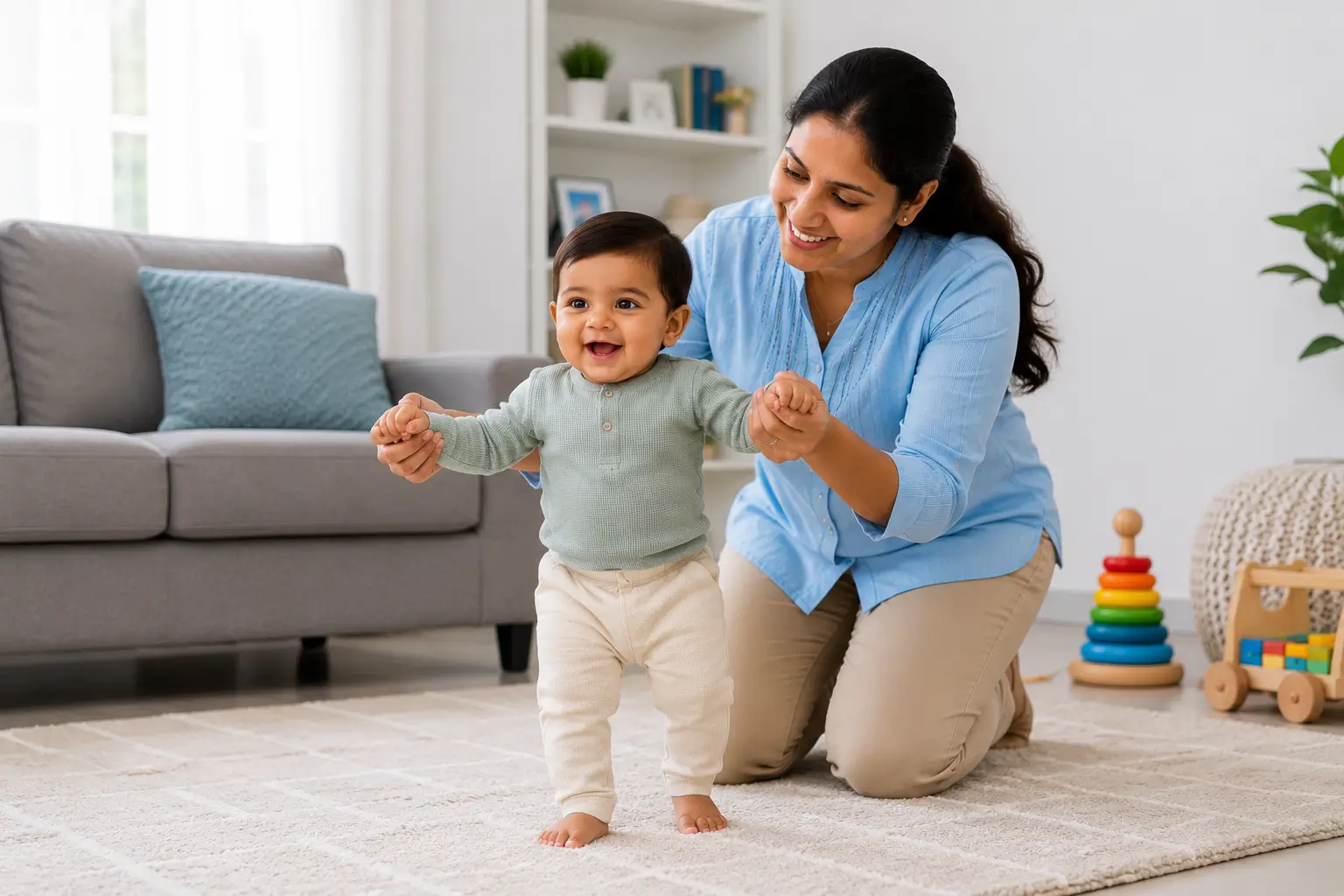
Few moments feel as exciting for a parent as watching their child take their very first steps. But what happens when those steps don’t come on time?
If your toddler hasn’t started walking while other kids their age are already toddling around, it’s natural to feel a quiet sense of worry creeping in.
Here’s the reassuring truth: in most cases, a slightly delayed start to walking isn’t a cause for alarm.
But in some cases, it can point to an underlying orthopedic issue that genuinely needs attention. Knowing the difference between the two is what this guide is all about.
What’s Considered “Normal” When It Comes to Walking?
Before jumping to conclusions, it helps to understand just how wide the normal range actually is. Most children take their first independent steps somewhere between 9 and 15 months, though it’s entirely common for some toddlers to wait until 17 or even 18 months before walking confidently on their own.
In fact, pediatric specialists generally consider walking to be delayed only if a child hasn’t started walking by 18 months. Until that point, there’s typically no need for concern, especially if your child is otherwise hitting other developmental milestones like sitting, crawling, and pulling themselves up to stand.
It’s also worth remembering that walking doesn’t happen in isolation. It’s the final step in a longer sequence: rolling over around 4 to 6 months, crawling between 6 and 10 months, and pulling up to stand around 9 to 12 months. If your child is moving steadily through these earlier stages, a slightly later start to walking is often just part of their own developmental rhythm, not a red flag.
So, When Does Delayed Walking Become an Orthopedic Concern?
While many delays resolve on their own, certain signs suggest it’s time to look closer, and an orthopedic evaluation can play a crucial role in figuring out why.
Hip dysplasia. This is one of the most commonly missed causes of walking delay in young children. It occurs when the hip joint doesn’t form correctly, making standing and walking uncomfortable or even painful. Signs can include one leg appearing shorter than the other, uneven thigh or buttock creases, or noticeably stiff hips.
Left undiagnosed, hip dysplasia tends to get harder to treat as a child grows, which is exactly why early orthopedic evaluation matters so much here.
Club foot or significant flat feet. Structural issues in the foot can directly affect a toddler’s balance and confidence when attempting to bear weight. The encouraging news is that most of these conditions respond very well to early treatment, often without the need for major intervention later on.
Persistent toe walking. It’s completely normal for toddlers under the age of three to occasionally walk on their toes. However, when toe walking continues well past age three, it’s considered something orthopedic specialists should evaluate, since persistent cases can sometimes be linked to muscle tightness or coordination difficulties that benefit from early correction.
Left unaddressed into adolescence, this pattern has even been associated with chronic foot pain and balance issues later in life.
Low muscle tone (hypotonia). Some children are simply born with weaker muscle tone, making it physically harder for them to bear weight on their legs. You might notice floppier limbs or difficulty sitting upright for extended periods. While this isn’t always a purely orthopedic issue, an orthopedic specialist is often part of the team that helps assess and guide treatment.
Bowed legs or knock knees beyond the expected age. Mild bowing or knock-knee posture is common in toddlers and usually self-corrects. But when these patterns are unusually pronounced or persist well past the age they typically resolve, an orthopedic assessment helps determine whether further evaluation or treatment is needed.
You can also read: Why Patients Prefer an Orthopedic Hospital in Gaya Over General Clinics
What an Orthopedic Evaluation Actually Involves
If you do decide to seek an orthopedic opinion, the process is far less intimidating than many parents expect. A pediatric orthopedic specialist will typically start with a physical examination, gently checking hip movement, leg alignment, and muscle response.
From there, depending on what they observe, they may recommend imaging such as an X-ray or ultrasound to get a clearer picture of how the bones and joints are developing.
The goal at this stage isn’t to jump straight to treatment, it’s simply to rule things in or out. Many children who go through this evaluation are found to be developing perfectly normally, just on their own slightly later timeline.
For the smaller number who do have an underlying issue, catching it early dramatically improves the range of treatment options available, often avoiding the need for more invasive intervention down the line.
Why Early Evaluation Matters More Than Parents Realize
It’s easy to adopt a “wait and see” approach, especially when a pediatrician reassures you that some kids simply walk later than others. And often, that reassurance is entirely correct. But when there is a genuine underlying issue, time matters more than most parents expect.
Conditions like hip dysplasia tend to be far more treatable with simple, non-surgical methods (like specialized braces) when caught early, compared to the more complex interventions sometimes needed if diagnosis is delayed into later childhood.
Similarly, persistent gait issues that go unaddressed through early childhood can carry forward into more entrenched patterns by the time a child reaches their teenage years.
This is precisely why pediatric orthopedic specialists consistently emphasize one simple principle: it costs nothing to ask, but it can cost months or years of more complicated treatment to wait too long.
You can also read: Fracture Treatment & Recovery: What To Expect From an Orthopedic Surgeon
A Quick Self-Check for Parents
If you’re unsure whether your child’s walking delay warrants a visit to an orthopedic specialist, ask yourself the following:
Is your child past 18 months and still not walking independently, even with support? Have you noticed one leg appearing shorter, or uneven creases on their thighs or buttocks? Does your toddler consistently walk on their toes well past the age of three? Do they seem to have unusually stiff or unusually floppy movement compared to other children their age?
Has progress through earlier milestones (sitting, crawling, standing) also felt slower than expected?
If you answered yes to any of these, it’s worth scheduling an evaluation, not out of panic, but out of the same instinct that makes you a good parent: paying attention when something feels a little off.
You can also read: 6 Signs You Should Visit a Bone Doctor in Gaya Immediately
How Healing Touch Hospital Supports Your Child’s Healthy Development
This is exactly the kind of evaluation and care that Healing Touch Hospital (HTH) in Gaya is equipped to provide. Led by Dr. Vimlendu Vimal, a senior orthopedic surgeon with over 25 years of experience spanning joint care, trauma treatment, and musculoskeletal conditions, HTH brings specialized orthopedic expertise to families in Gaya without requiring a long trip to a metro city.
For concerns around delayed walking, gait abnormalities, or suspected hip and limb conditions in children, HTH’s orthopedic department offers patient-specific evaluation, supported by experienced medical professionals and modern diagnostic equipment.
Rather than navigating a confusing referral process across multiple clinics, families can get a clear, focused assessment and a defined treatment plan in one place.
Parents who’ve visited HTH consistently mention the clarity and compassion of the care they received. One patient shared that the team explained every step of treatment clearly, combining professionalism with genuine compassion, an approach that matters enormously when the patient in question is a worried child and an even more worried parent.
Another highlighted the transparent, pressure-free approach to recommending only the tests and treatments genuinely needed, rather than unnecessary procedures, something parents especially appreciate when it comes to their child’s care.
With true 24/7 availability, HTH also means that if a sudden concern arises, whether it’s a fall, an injury, or a sharp change in how your child is walking, families in Gaya don’t have to wait or travel to get answers.
You can also read: 5 Tips To Choose The Best Orthopedic Doctor In Gaya For Joint & Bone Problems
Trust Your Instincts, and Get the Clarity You Deserve
Most delayed walking resolves on its own, and there’s truly no need to panic the moment your toddler’s first steps come a little later than your neighbor’s child. But when something feels persistently off, whether it’s uneven hips, ongoing toe walking, or a child who simply isn’t progressing the way you’d expect, getting a specialist’s perspective offers something invaluable: clarity.
Get Expert Pediatric Orthopedic Guidance in Gaya
If you have concerns about your child’s walking development, don’t wait for the worry to grow. Healing Touch Hospital in Gaya offers experienced orthopedic evaluation and care, led by a surgeon with over 25 years of expertise, to help you understand exactly what’s going on and what (if anything) needs to be done.
Call Healing Touch Hospital today at (+91) 99316 23835 or reach out at contact@hthgaya.com to schedule a consultation. You can also visit the hospital at South Church Road, Behind Hotel Gharana, Jaiprakash Nagar, Gaya, Bihar.
Your child’s first steps deserve the right support, right from the start.