When people search for answers about slip disc vs muscle pain and how orthopedic doctors diagnose back pain, they are usually in the middle of something uncomfortable and genuinely worrying: persistent back pain that is not going away on its own.
The frustration is real because both conditions can feel remarkably similar in the early stages, and guessing wrong about what is causing your pain often leads to weeks of the wrong treatment and no real relief.
Back pain is one of the most widespread health complaints in India right now.
A major cross-sectional study published in Cureus in May 2025, analyzing data from 16,866 patients across 76 centers in 18 Indian states, found that low back pain prevalence rose significantly to 22.63% by 2023, its highest point in the five-year study period.
Globally, low back pain remains a leading cause of disability, and as StatPearls 2026 notes, mechanical and non-specific disorders account for the majority of presentations across all age groups.
Understanding whether your pain is coming from a muscle or a disc is not just medically important. It is the difference between recovering in days versus needing months of treatment.
What is a Slip Disc?
A slip disc, medically known as a herniated or prolapsed intervertebral disc, occurs when the soft inner material of a spinal disc pushes through a crack in its tougher outer layer.
This protruding material can press against nearby nerves, causing pain that is often far more complex than simple back soreness.
The spine is made up of vertebrae stacked on top of each other, with discs sitting between them acting as cushions and shock absorbers.
When one of these discs herniates, it stops doing its job effectively and starts creating pressure on the surrounding nerve roots instead.
Disc herniation most commonly occurs in the lower back, known as the lumbar region, and less frequently in the neck, known as the cervical region.
Contributing factors to slip disc cases in India include prolonged sitting, poor posture while using mobile phones and laptops, obesity, weak core muscles, and lifting heavy objects with incorrect technique.
Long hours of desk work reduce disc nutrition over time, while lack of core strength means the spine receives less support during even routine daily activities.
You can also read: Common Knee Problems Treated by Orthopedic Doctors in Gaya
What is Muscle Pain in the Back?
Muscle pain, or musculoskeletal back pain, is caused by strain, tension, or injury to the muscles and ligaments supporting the spine.
It is the most common form of back pain overall, and unlike disc-related pain, it does not involve any pressure on the nerves.
It typically results from overexertion, a sudden awkward movement, poor posture sustained over time, or prolonged stress that causes the back muscles to tighten chronically.
Muscle pain tends to be localized, meaning it stays in one general area of the back without travelling down the leg or into the arm.
It is often described as a dull ache or tightness that worsens with movement and eases somewhat with rest, heat, or gentle stretching.
For most people, muscle-related back pain improves significantly within a few days to a couple of weeks with conservative management.
How the Two Conditions Feel Differently
Understanding the symptomatic differences is the first step toward knowing when to seek specialist evaluation rather than simply waiting for pain to resolve on its own.
Location and spread of pain. Muscle pain is generally confined to the back itself, either the upper, mid, or lower region. Slip disc pain, by contrast, often radiates outward along the path of the affected nerve.
Lumbar disc herniation frequently causes sciatica, a sharp, shooting pain that travels from the lower back down through the buttock and into the leg, sometimes reaching the foot.
Cervical disc herniation can send pain, numbness, or tingling down the arm.
Character of the pain. Muscle pain tends to feel like soreness, stiffness, or a dull ache.
Disc-related nerve pain is typically described as sharper, burning, or electric in character, and it can be accompanied by numbness, weakness, or a pins-and-needles sensation in the affected limb.
Triggers and relievers. Muscle pain is usually worsened by specific movements and relieved by rest or warmth.
Disc pain is often worsened by sitting for extended periods, coughing, sneezing, or bending forward, since these actions increase pressure on the disc and the compressed nerve.
Duration and pattern. Muscle pain that results from a simple strain typically improves meaningfully within one to two weeks.
Pain from a herniated disc tends to be more persistent, more variable in intensity, and frequently accompanied by neurological symptoms that do not appear in pure muscle injuries.
You can also read: Knee Pain in Young Adults: Causes, Treatment &When to see an Orthopedic Surgeon
How Orthopedic Doctors Actually Diagnose Back Pain
This is where specialist evaluation becomes genuinely valuable. Many patients arrive at a clinic having already self-diagnosed, having spent days assuming their pain is muscular when it may not be, or fearing a serious disc problem when the cause is far simpler.
An orthopedic specialist uses a structured, layered diagnostic approach to reach an accurate conclusion rather than guessing.
Clinical history. The first and often most revealing step is a detailed conversation about your symptoms.
The doctor will ask when the pain started, what makes it worse or better, whether it radiates anywhere, whether you have numbness or weakness in your limbs, and whether there were any triggering events.
The pattern of answers already begins to separate muscular from neurological causes.
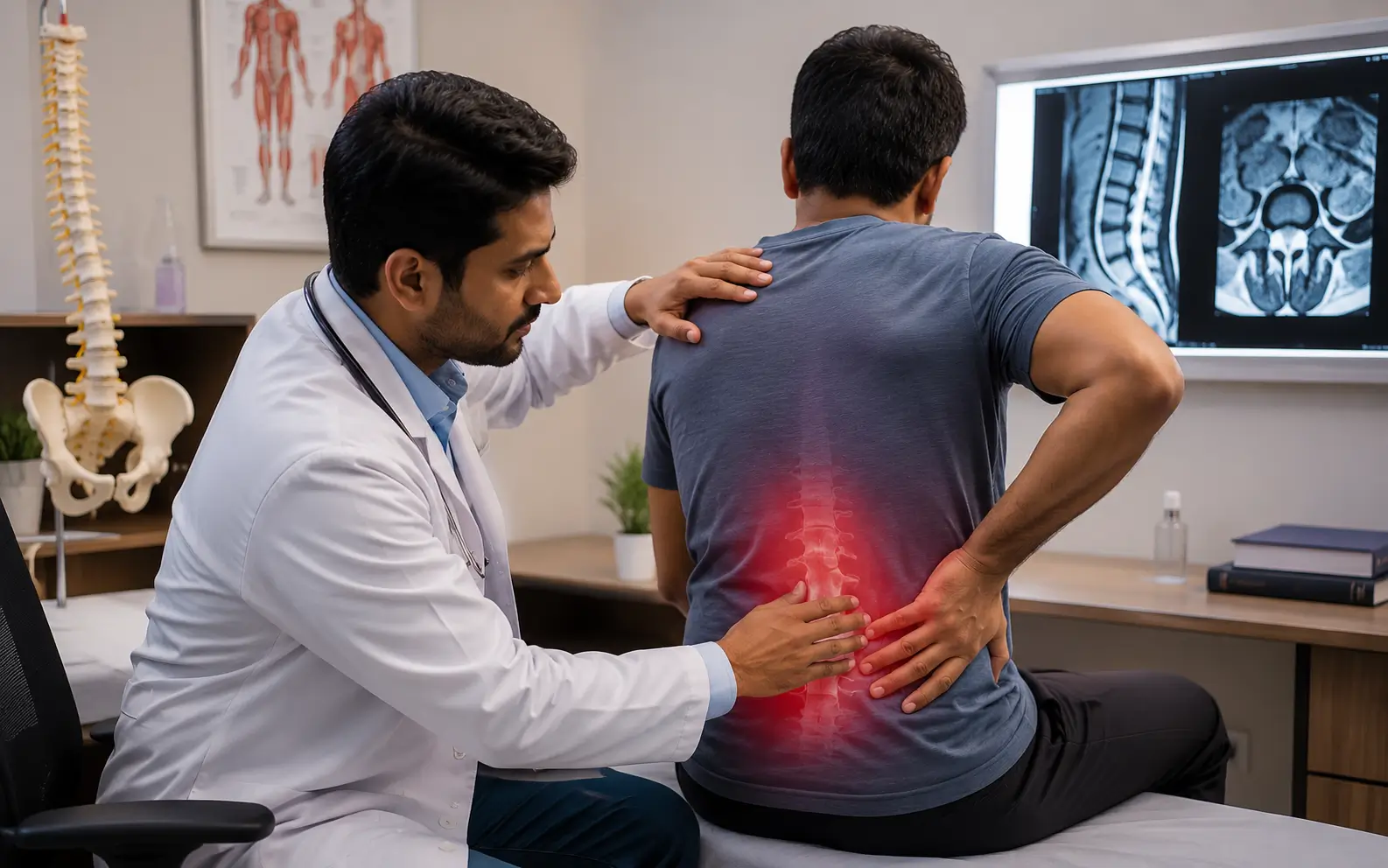
Physical examination. Specific orthopedic tests can identify nerve involvement without any imaging at all.
The Straight Leg Raise test, for example, involves lifting the patient’s leg while they lie flat. If this reproduces the radiating leg pain, it strongly suggests lumbar disc herniation with nerve compression.
Reflex testing, muscle strength assessment, and sensory checks in the limbs further help map whether a nerve root is genuinely being compressed and if so, which one.
Imaging. X-rays are used to rule out fractures, infections, and bony alignment issues, but they do not show disc material or nerves.
MRI is the gold standard for diagnosing herniated discs, providing detailed images of soft tissue including the discs, spinal cord, and nerve roots.
CT scans are sometimes used when MRI is unavailable. A skilled clinician’s physical examination will often accurately predict what the MRI will confirm, which is why evaluation and imaging work best together rather than relying on imaging alone.
Why accurate diagnosis matters so much. Treating muscle pain with disc herniation protocols, or vice versa, wastes time and delays recovery.
A patient with muscle pain subjected to unnecessary spine protocols may be kept from simple physiotherapy that would resolve their pain quickly.
A patient with genuine disc herniation told to simply rest may allow nerve compression to worsen, risking longer-term neurological damage.
You can also read: Total Joint Replacement Surgery: When It’s Needed and What to Expect
When You Should Not Wait
Most back pain episodes are not emergencies, but certain symptoms require prompt specialist attention.
Seek evaluation immediately if your back pain is accompanied by loss of bladder or bowel control, progressive leg weakness, severe pain following a fall or injury, or pain combined with unexplained fever or weight loss.
Additionally, any back pain that has not meaningfully improved after two weeks of basic home care, or any pain accompanied by radiating numbness, tingling, or weakness in the limbs, warrants an orthopedic consultation rather than continued self-management.
You can also read: When Should You Consult a Pediatric Orthopedic Surgeon in Gaya?
How Healing Touch Hospital Diagnoses and Treats Back Pain in Gaya
For patients in Gaya and across Bihar, accurate back pain diagnosis is now available locally without the need to travel to Patna or further for specialist care.
Healing Touch Hospital, led by Dr. Vimlendu Vimal, MBBS, D.Ortho (Patna), FIMS, and former orthopedic surgeon at ESI Hospital New Delhi, brings over 25 years of orthopedic expertise directly to Gaya.
Dr. Vimlendu’s diagnostic approach to back pain reflects the layered methodology described in this blog: detailed history taking, structured physical examination, and appropriate imaging interpreted by an experienced specialist.
Rather than defaulting to surgery or heavy medication as a first response, the team at HTH evaluates each patient’s specific presentation, lifestyle, and goals before recommending a treatment path, which for many patients means non-surgical management through physiotherapy, targeted medication, and postural correction.
Patients consistently highlight the clarity of communication at HTH, especially important when a diagnosis can feel anxiety-inducing.
One patient described the team explaining every step of treatment transparently and with genuine compassion. Another shared that after years of recurring back pain, the team finally delivered an accurate diagnosis and a structured plan that brought lasting relief.
With genuine 24/7 emergency availability, HTH ensures that acute back injuries or sudden neurological symptoms are assessed without delay.
The Right Diagnosis Changes Everything
Back pain is common, but that does not mean it should be ignored or guessed at. Whether your pain is coming from an overworked muscle or a herniated disc pressing on a nerve, the right diagnosis from the right specialist changes everything about how quickly and completely you recover.
Book Your Back Pain Consultation at Healing Touch Hospital, Gaya
If back pain is affecting your daily life and you are not sure whether it is muscular or disc-related, do not wait for it to get worse. Dr. Vimlendu Vimal and the team at Healing Touch Hospital provide expert orthopedic diagnosis and personalized treatment plans for all spinal conditions.
Call Healing Touch Hospital today at (+91) 99316 23835 or write to contact@hthgaya.com to book your consultation.
Visit at: South Church Road, Behind Hotel Gharana, Jaiprakash Nagar, Gaya, Bihar 823001.
Your back carries you through everything. Give it the care it deserves.