Watching your child grow up is one of life’s most rewarding journeys. From those fragile first steps to sprinting across playgrounds, every milestone is a moment to celebrate.
However, because a child’s skeletal system develops rapidly, parents often worry when they notice an unusual gait, persistent complaints of leg pain, or a sudden injury.
As a parent in Gaya, you might wonder whether a minor limp is just a temporary phase or a sign of something deeper.
While general pediatricians are excellent for routine childhood illnesses, specialized issues concerning bones, joints, and muscles require a highly focused expert: a pediatric orthopedic surgeon.
Understanding when to transition from watchful waiting to seeking professional medical attention can prevent long-term mobility issues.
This comprehensive guide outlines the critical signs that indicate it is time to consult a pediatric orthopedic surgeon in Gaya and highlights how Healing Touch Hospital can support your family’s health journey.
Why Children Need Specialized Orthopedic Care
It is a common misconception that children are simply “miniature adults.” From a medical standpoint, their skeletal anatomy is entirely unique.
A child’s bones are highly flexible and contain specialized zones known as growth plates (epiphyseal plates).
These are areas of active new bone growth near the ends of the long bones. Because these plates are still developing, they are highly susceptible to unique injuries and deformities that do not occur in mature adult skeletons.
According to epidemiological data published in the Journal of Pediatric Orthopaedics, musculoskeletal injuries account for nearly 10% to 15% of all childhood trauma cases.
If a growth plate injury is misdiagnosed or treated with standard adult orthopedic protocols, it can lead to permanent growth arrest, limb length discrepancies, or angular deformities. Consequently, getting a precise diagnosis from a pediatric specialist is essential for your child’s proper physical development.
You can also read: Knee Pain In Young Adults: Causes, Treatment And When To See An Orthopedic Surgeon
Key Signs It’s Time to See a Pediatric Orthopedic Surgeon
Navigating childhood milestones means knowing what is normal and what warrants a specialist’s evaluation.
Below are the structural, congenital, and traumatic indicators that require an expert assessment.
1. Congenital Conditions and Early Childhood Deformities
Some orthopedic issues are present right at birth or manifest during infancy.
Catching these early yields the most effective, non-invasive results.
-
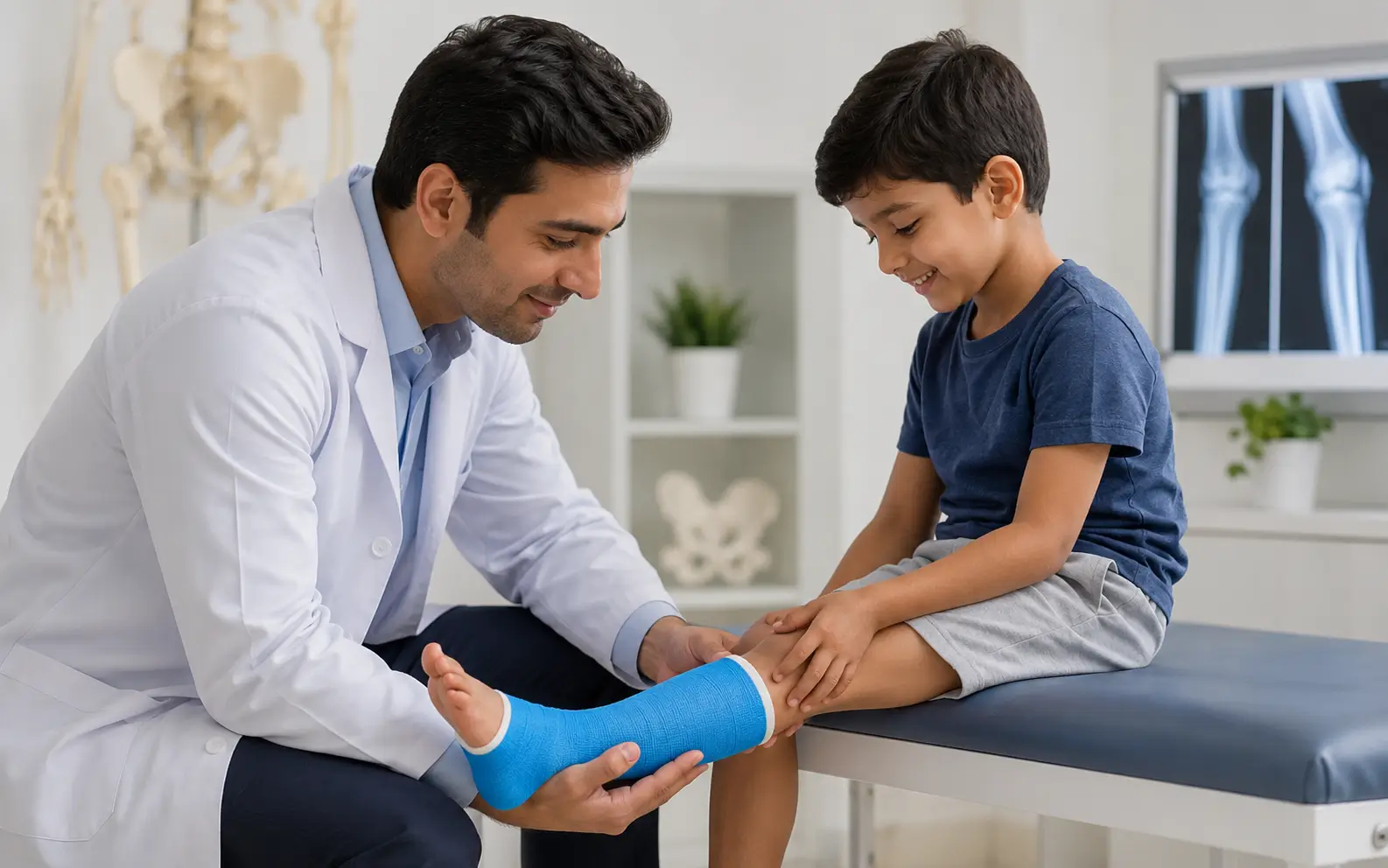
Clubfoot (Talipes Equinovarus): This is a congenital condition where a newborn’s foot is turned sharply inward and downward.
Global clinical data shows that clubfoot affects approximately 1 in every 1,000 live births. Fortunately, when managed early by a pediatric specialist using the non-surgical Ponseti method (a sequence of gentle casting), structural correction can achieve a success rate greater than 95%.
-
Developmental Dysplasia of the Hip (DDH): This condition occurs when a child’s hip joint does not form properly, causing the ball of the joint to easily dislocate.
If you notice asymmetrical fat folds on your infant’s thighs or hear a distinct “clicking” sound during diaper changes, an immediate orthopedic ultrasound or screening is critical.
You can also read: Total Joint Replacement Surgery: When Its Needed And What To Expect
2. Persistent Limping or Changes in Gait
It is common for toddlers to stumble while mastering balance. However, a persistent limp is never normal.
If your child favors one leg for more than 48 hours without an obvious cause, it requires immediate attention.
A limp can indicate deep-seated issues ranging from transient synovitis (temporary joint inflammation) to severe conditions like Perthes disease (temporary loss of blood supply to the hip) or Slipped Capital Femoral Epiphysis (SCFE), which frequently occurs in adolescents.
3. Progressive Limb Alignment Issues (Bowlegs and Knock-Knees)
During early childhood development, a certain degree of structural variation is expected:
-
Bowlegs (Genu Varum): Common in infants, this typically straightens out naturally by the age of 2.
-
Knock-Knees (Genu Valgum): Frequently observed in children aged 3 to 4, this usually resolves on its own by age 7 or 8.
However, if these alignments appear strictly on one side (asymmetrical), worsen progressively over time, or persist past the expected developmental ages, it could be a sign of underlying conditions like Rickets or Blount’s disease.
A pediatric specialist can evaluate whether your child requires simple corrective bracing or surgical guidance.
You can also read: Fracture Treatment And Recovery: What To Expect From An OrthoPedic Surgeon
4. Signs of Childhood Scoliosis (Spinal Curvature)
As children enter rapid growth spurts, typically between the ages of 10 and 15, the spine can sometimes develop a lateral or “S-shaped” curvature known as scoliosis.
What to look for: Watch your child from behind. Are their shoulders uneven? Does one shoulder blade stick out more than the other? Does their waist look asymmetrical when they bend forward?
According to the Scoliosis Research Society, idiopathic scoliosis affects roughly 2% to 3% of adolescents. Early detection is absolutely vital; timely orthopedic intervention using modern bracing can stop the curve from progressing, preventing the need for complex spinal fusion surgery later in life.
      NORMAL SPINE                SCOLIOSIS CURVATURE
          │                              ▲
          │                             / \
          │                            │   │  <- Uneven shoulders
          │                             \ /
          │                              │
          │                            (   )  <- S-shaped curve
          │                             \ /
5. Traumatic Injuries, Fractures, and Sports Impact
Children are natural explorers, which occasionally leads to structural injuries. You should seek specialized orthopedic care if your child experiences:
-
Inability to bear weight on a limb after a fall.
-
Visible swelling, severe bruising, or joint deformity.
-
A suspected fracture near a joint, which could directly compromise an active growth plate.
You can also read: Back Pain & Spine Problems: When To See An Orthopedic Surgeon
The Risks of Delaying Pediatric Orthopedic Care
As a parent, it is easy to fall into the trap of hoping a physical issue is simply a “growing pain.” However, delaying a specialist consultation can result in long-term developmental setbacks.
Because a child’s bones heal rapidly, a fracture that misaligns can begin setting incorrectly within days, making correction much more difficult.
Similarly, untreated walking abnormalities alter how weight shifts across joints, causing early wear and tear on the knees, hips, and spine by the time they reach adulthood. Seeking timely, professional care ensures your child’s skeleton grows straight, strong, and pain-free.
Healing Touch Hospital: Your Trusted Destination for Orthopedic Care in Gaya
When it comes to your child’s mobility, you shouldn’t have to travel to distant metro cities to find top-tier medical expertise. Located conveniently in Gewal Bigha, Healing Touch Hospital stands as a premier center for advanced healthcare and specialized orthopedic treatment in Gaya.
Led by Dr. Vimlendu Vimal, a highly respected Senior Orthopedic Surgeon with more than 25 years of surgical excellence, Healing Touch Hospital brings specialized clinical protocols directly to families across Bihar.
The hospital features state-of-the-art diagnostic facilities and modern surgical theaters designed to prioritize patient safety and long-term recovery.
Why Families Choose Healing Touch Hospital:
-
Decades of Specialized Expertise: Dr. Vimlendu Vimal’s extensive experience in managing complex bone, joint, and trauma care ensures your child receives accurate diagnoses and gentle, effective treatment.
-
Comprehensive Multispecialty Support: Unlike isolated clinics, Healing Touch Hospital provides a fully integrated approach. With dedicated pediatric and orthopedic resources under one roof, your family benefits from seamless, coordinated medical care.
-
24/7 Emergency Trauma Care: Accidents don’t wait for regular clinic hours. The hospital operates a round-the-clock emergency department fully equipped to stabilize and treat acute fractures, dislocations, and childhood injuries immediately.
-
Compassionate, Family-Centered Environment: The medical teams and dedicated physiotherapists understand that treating a child requires extra patience, warmth, and clear communication with worried parents.
What to Expect During Your First Visit
Your first consultation is focused entirely on understanding your child’s unique needs and making them feel comfortable. The specialist will carefully review your child’s medical history, track their developmental milestones, and perform a gentle physical examination.
If diagnostic tests like high-resolution X-rays or basic lab work are necessary, they can be handled directly on-site to save you time. From there, the team will map out a clear, customized care plan.
Whenever possible, non-surgical approaches, such as specialized exercises, physical therapy, or corrective bracing, are prioritized to support your child’s natural healing and growth.
Give Your Child the Gift of Pain-Free Mobility
Your child’s physical development lays the foundation for a healthy, active adult life. Recognizing the early warning signs of developmental or traumatic bone issues and acting quickly ensures they can run, play, and grow without limitations.
If you have noticed an unusual limp, uneven posture, or persistent joint pain in your child, don’t wait for the issue to resolve on its own. Protect their growing steps by scheduling a specialist evaluation today.
Contact Healing Touch Hospital to book an expert consultation.
-
📍 Address: South Church Road, Near Gharana Hotel & Maharani Petrol Pump, Gewal Bigha, Gaya, Bihar – 823001
-
🌐 Official Website: hthgaya.com
-
📞 Emergency Line & Appointments: Available 24/7 for trauma and urgent care.