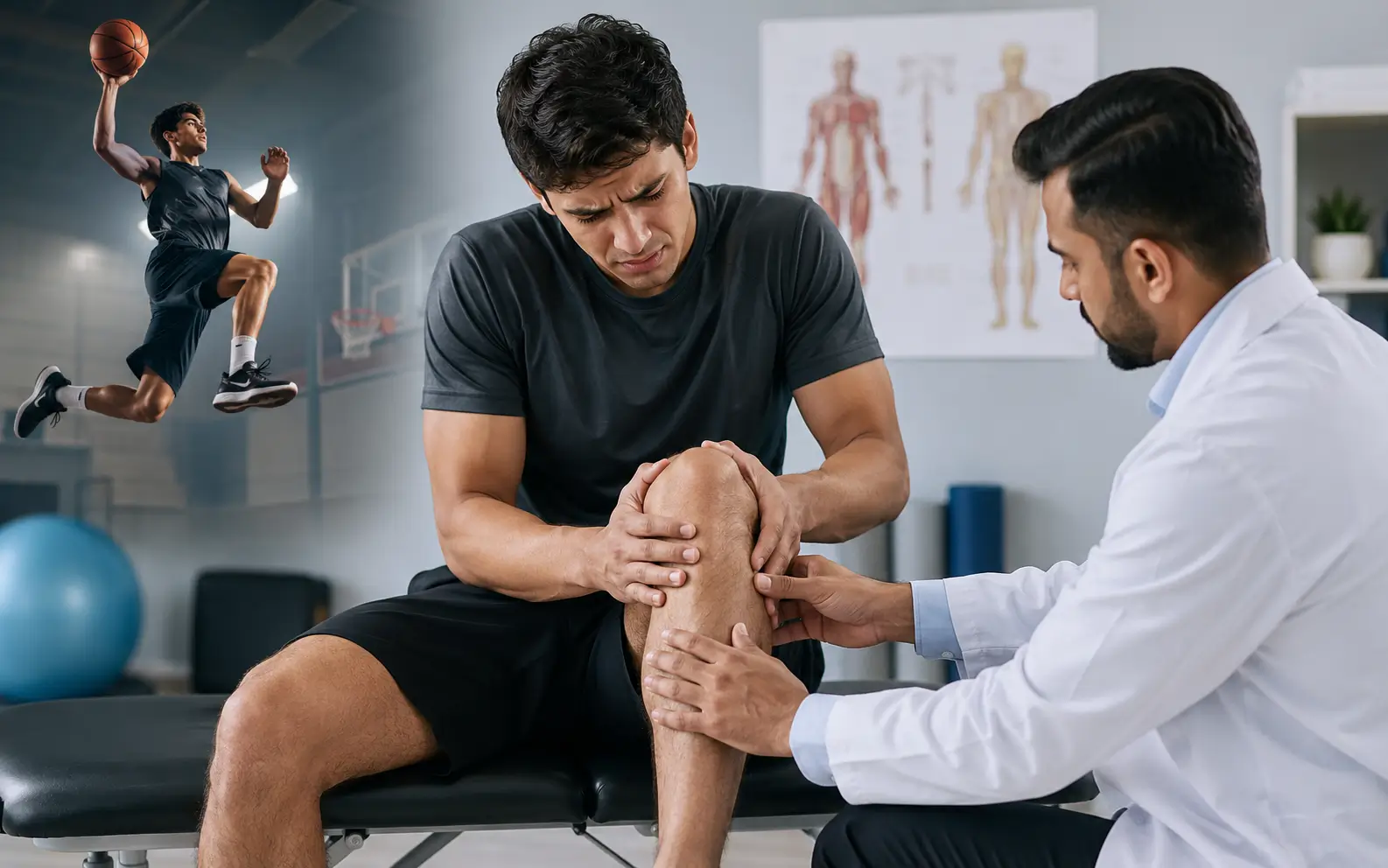
If you are a young adult dealing with pain after a sports injury and wondering when to visit an orthopedic surgeon, you are not alone and you are asking exactly the right question.
Sports injuries in young adults are among the most commonly mismanaged health conditions in India, not because treatment is unavailable, but because too many people either dismiss the pain as temporary or wait far longer than they should before seeking specialist care.
The numbers tell a clear story. A cross-sectional study published in Cureus in August 2025, conducted across five sports academies in Uttar Pradesh, found that sports-related injuries are a critical concern particularly among adolescents and young adults actively involved in athletic pursuits, with musculoskeletal and soft tissue injuries being the most prevalent category.
In India more broadly, over 2.6 million young people aged 0 to 19 are treated annually for sports and recreation-related injuries.
And orthopedic specialists speaking on Doctors’ Day 2026 specifically flagged that joint and back problems are no longer limited to older adults, with young adults in their 20s and 30s increasingly presenting with sports-related musculoskeletal conditions that are being worsened by delayed care.
Understanding which injuries need immediate specialist attention and which can be managed conservatively at home is what this guide is about.
Why Young Adults Are Particularly Vulnerable
Young adults occupy a unique risk category when it comes to sports injuries. On one hand, they are typically physically active, which is entirely positive.
On the other hand, that same activity level, combined with factors like inadequate warm-up, improper technique, overtraining without adequate rest, and the absence of protective equipment, creates consistent exposure to injury.
Contact sports like football, kabaddi, and wrestling carry naturally higher injury risks. But non-contact activities are not without danger either.
Overuse injuries, which develop gradually from repetitive stress on a specific body part, are extremely common among runners, cricketers, and gym-goers who train intensively without adequate recovery. High-intensity workouts without proper guidance also contribute significantly to musculoskeletal strain, particularly in young adults pushing their physical limits for the first time.
You can also read: Common Knee Problems Treated by Orthopedic Doctors in Gaya
The Most Common Sports Injuries in Young Adults
Knowing what you are dealing with is the first step toward knowing how serious it is.
ACL tears. The anterior cruciate ligament is one of the four major stabilizers of the knee joint, and it is among the most commonly injured structures in Indian sports medicine. ACL tears typically occur during sudden pivoting movements, awkward landings from jumps, or direct impacts to the knee.
The injury is usually accompanied by a distinct pop, immediate swelling, and an inability to bear weight without pain. Research from Indian orthopedic literature consistently shows that ACL tears account for the majority of sport-related knee injuries requiring specialist care.
Meniscal injuries. The menisci are two cartilage pads inside the knee that act as shock absorbers. They tear during the same kinds of rotational forces that cause ACL injuries but are also vulnerable to cumulative stress over time. Symptoms include pain along the inner or outer knee, stiffness, swelling, and a catching or locking sensation when bending the joint.
Ankle sprains. One of the most frequent sports injuries across all age groups, ankle sprains occur when the foot rolls inward or outward beyond its normal range, stretching or tearing the ligaments on the outer or inner side.
While minor sprains do heal with conservative management, more severe ligament tears that are not properly assessed and rehabilitated frequently lead to chronic ankle instability and repeated injuries.
Shoulder dislocations. Common in contact sports and throwing activities, a shoulder dislocation occurs when the upper arm bone is forced out of the shoulder socket. Young adults are particularly prone to recurrent dislocations if the initial injury is not properly managed, since the surrounding soft tissue may not fully stabilize the joint after the first event.
Stress fractures. Unlike traumatic fractures caused by a single impact, stress fractures develop gradually from repetitive loading. They are common in runners, jumpers, and young athletes who have recently increased their training volume.
The shin bone, foot, and hip are the most frequently affected sites. Because stress fractures often start as a dull ache that worsens with activity rather than a dramatic injury, they are frequently dismissed until the pain becomes severe enough to limit function.
Tennis elbow and overuse tendinopathies. These are classic overuse conditions affecting the tendons around major joints. Tennis elbow, technically lateral epicondylitis, causes pain on the outer side of the elbow and is common not just in racket sports but in any activity involving repetitive wrist and forearm movement.
Similar overuse patterns affect the shoulder (rotator cuff tendinopathy) and the knee (patellar tendinopathy or jumper’s knee).
You can also read: Knee Pain in Young Adults: Causes, Treatment &When to see an Orthopedic Surgeon
The Critical Difference: Minor Injury vs. Specialist-Level Problem
Most minor sports injuries, a mild ankle twist, a muscle strain from overexertion, or general post-exercise soreness, do respond well to the standard first-aid approach of rest, ice, compression, and elevation combined with a few days of reduced activity. The difficulty is that the line between a minor injury and something requiring orthopedic evaluation is not always obvious in the first 24 to 48 hours.
Here is the practical guide to when conservative home management is appropriate and when it is not.
Home management is reasonable for mild muscle soreness after exercise that improves within 48 hours, a minor ankle twist with minimal swelling and full weight-bearing ability, and mild bruising or stiffness that is clearly improving day by day.
An orthopedic surgeon should be consulted when pain persists beyond two weeks without meaningful improvement, when there is significant swelling that appears suddenly after an injury, when the joint feels unstable or gives way during normal movement, when you heard or felt a pop at the moment of injury, when you cannot bear weight on the injured limb, when numbness or tingling develops in the limb, and when a previously minor injury keeps recurring despite seemingly adequate rest.
Ignoring sports injuries or delaying specialist treatment leads to chronic pain, prolonged recovery, and in some cases, long-term joint damage that would have been far more easily managed had it been assessed early.
Native joint preservation is particularly important in younger patients, which means catching injuries early enough to manage them without surgery is consistently the best possible outcome.
You can also read: Total Joint Replacement Surgery: When It’s Needed and What to Expect
What Happens at an Orthopedic Consultation for a Sports Injury
Many young adults avoid seeking orthopedic care because they assume it will lead directly to surgery. In reality, the majority of sports injury consultations result in non-surgical management plans.
The process starts with a structured physical examination to assess the injury’s location, severity, and functional impact, followed by appropriate imaging when needed. X-rays rule out fractures, while MRI provides the detail needed to assess soft tissue injuries like ligament tears and meniscal damage.
From there, the team recommends a treatment plan that may involve physiotherapy, bracing, activity modification, anti-inflammatory management, or in cases where surgery is necessary, minimally invasive arthroscopic procedures associated with faster recovery and lower complication rates.
How Healing Touch Hospital Treats Sports Injuries in Gaya
For young adults in Gaya and across Bihar, Healing Touch Hospital offers the kind of specialist orthopedic assessment and treatment that sports injuries genuinely require, without the need to travel to Patna or a metro city for quality care.
Led by Dr. Vimlendu Vimal, MBBS, D.Ortho (Patna), FIMS, and former orthopedic surgeon at ESI Hospital New Delhi, HTH brings over 25 years of surgical expertise in joint injuries, trauma care, and musculoskeletal conditions.
Dr. Vimlendu’s approach to sports injuries reflects exactly the philosophy that modern orthopedic research supports: accurate diagnosis first, conservative management wherever it is genuinely sufficient, and surgical intervention only when it offers a clearly better long-term outcome.
Patients consistently highlight both the clinical quality and the communication style at HTH. One patient described finally receiving a clear, structured diagnosis and treatment plan after months of worsening pain that had been dismissed elsewhere.
Another praised the team’s transparent approach, noting that every step of the treatment process was explained clearly so that they understood what was happening and why, which made the entire recovery process far less stressful.
With genuine 24/7 emergency availability, HTH also ensures that acute sports injuries, a sudden ligament tear, a dislocated shoulder, or a stress fracture that has become unbearable, are assessed and stabilized promptly rather than left unmanaged overnight.
You can also read: Back Pain & Spine Problems: When to see an Orthopedic Surgeon
Do Not Let a Sports Injury Become a Chronic Problem
The most important thing to understand about sports injuries in young adults is that the body’s ability to heal is genuinely at its best at this stage of life. Getting the right care at the right time gives you the best possible chance of a complete recovery and a return to full activity.
Waiting, or hoping it will resolve on its own when it is not improving, turns a manageable acute injury into a chronic condition that becomes progressively harder to treat well.
Book Your Sports Injury Consultation at Healing Touch Hospital, Gaya
If you are dealing with a sports injury that is not improving, or if you are unsure whether your injury needs specialist attention, do not delay the conversation. Dr. Vimlendu Vimal and the team at Healing Touch Hospital are ready to assess, diagnose, and treat your injury with the expertise and care it deserves.
Contact us or Call Healing Touch Hospital today at (+91) 99316 23835 or write to contact@hthgaya.com to book your consultation.
Visit at: South Church Road, Behind Hotel Gharana, Jaiprakash Nagar, Gaya, Bihar 823001.
Get back to doing what you love, the right way.