When patients and families search for answers about bone fracture treatment in Gaya and when surgery is necessary, they are usually dealing with something that happened suddenly and without warning.
A bad fall, a road accident, a sports injury, or sometimes just an awkward movement that ended with a crack and a level of pain that made it immediately clear something was seriously wrong.
The fear that follows a fracture is understandable. Questions come fast: is this bad enough for surgery? What happens if it does not heal properly? How long will recovery take? And most urgently for patients in Gaya and across Bihar: where can I get the right treatment without traveling to a metro city?
This guide answers those questions clearly, explains how orthopedic doctors decide between surgical and non-surgical fracture treatment, and helps you understand what to expect at every stage of care.
What Exactly is a Bone Fracture?
A bone fracture is simply a break in the continuity of the bone. It can range from a hairline crack that is barely visible on an X-ray to a complete break where the bone snaps into two or more pieces.
India conducted over 5.6 million orthopedic procedures in 2022, and trauma fixation for fractures remains one of the most performed categories, reflecting just how common fractures are across the country.
Fractures are broadly classified by their pattern and severity. A closed fracture means the broken bone has not pierced through the skin. An open or compound fracture, by contrast, involves the bone breaking through the skin surface, which significantly increases the risk of infection and almost always requires surgical intervention.
Comminuted fractures, where the bone shatters into multiple fragments, and displaced fractures, where the broken ends have shifted out of alignment, are also types that more frequently require surgery to restore proper bone positioning.
You can also read: Common Knee Problems Treated by Orthopedic Doctors in Gaya
Non-Surgical Fracture Treatment: When It Works Well
The good news for many fracture patients is that surgery is not always necessary. A significant number of fractures heal effectively with non-surgical management, provided the bone is properly aligned or can be manually repositioned without an operation.
Non-surgical treatment typically involves immobilization of the fractured area using a cast, splint, or brace. This keeps the bone ends stable while the body’s natural healing process rebuilds the bone tissue.
Depending on the fracture location and severity, immobilization may last anywhere from three to twelve weeks, followed by physiotherapy to restore strength and range of motion.
Non-surgical treatment works well for stable fractures where the bone fragments are still in acceptable alignment, for hairline or stress fractures without displacement, for many wrist and ankle fractures in younger patients with good bone density, and for certain rib and clavicle fractures that do not involve significant displacement.
The key factor in all of these is that the bone can heal in the correct position without surgical correction.
You can also read: Knee Pain in Young Adults: Causes, Treatment &When to see an Orthopedic Surgeon
When Surgery Becomes Necessary
The decision to operate on a fracture is not taken lightly by any orthopedic surgeon. It involves weighing the risks of surgery against the very real risks of allowing a fracture to heal improperly without intervention. There are specific clinical situations where surgery consistently delivers better outcomes than conservative management.
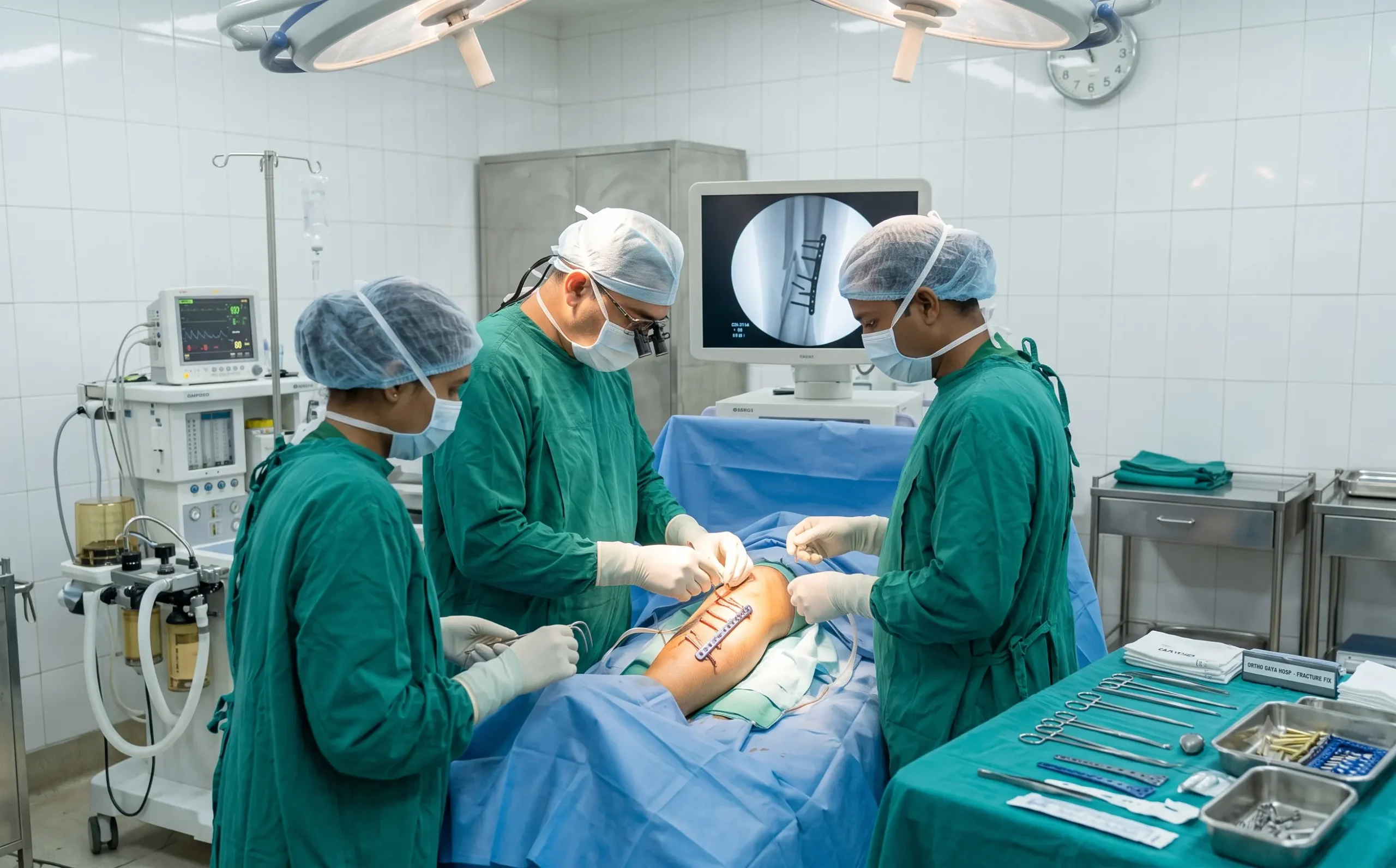
Displaced fractures that cannot be held in place. When a fracture causes the bone ends to shift significantly out of alignment and that alignment cannot be maintained with a cast alone, surgery is needed to reposition the fragments and hold them in place with internal fixation devices such as plates, screws, rods, or nails.
Without correction, the bone may heal in a malformed position, affecting function, causing chronic pain, or requiring more complex corrective surgery later.
Open or compound fractures. When the bone has broken through the skin, surgical cleaning of the wound combined with internal or external fixation is necessary to prevent life-threatening infection and ensure proper healing. These are always treated as urgent cases.
Fractures involving joint surfaces. When a fracture extends into a joint, such as a fractured ankle, knee, hip, or wrist joint surface, precise surgical realignment is critical. Even small inaccuracies in joint surface positioning can lead to post-traumatic arthritis, chronic pain, and long-term loss of function.
Surgery allows the orthopedic team to restore the joint surface as close to its original anatomy as possible.
Hip fractures in older adults. This is one of the most important surgical decisions in orthopedic trauma care. Research consistently shows that elderly patients with hip fractures who are treated surgically have significantly better outcomes than those managed non-operatively.
Studies show that surgical fixation for hip fractures in older patients reduces mortality risk and dramatically improves the chances of regaining independent mobility, making early surgery the standard of care in most cases.
Fractures in long bones like the femur. Major fractures of the thigh bone (femur) almost always require surgical fixation with an intramedullary nail or plate due to the forces the bone must withstand during recovery.
Research tracking femoral fracture surgeries from 2017 to 2022 found nonunion rates of just 1.7% to 2.1% with proper surgical fixation, reflecting how effective modern fixation techniques are when applied correctly and promptly.
Fractures that fail to heal with conservative management. Occasionally, a fracture that was initially managed without surgery does not heal properly, a condition called nonunion or malunion. When this happens, surgical intervention becomes necessary to correct the alignment and stimulate proper bone healing.
You can also read: Total Joint Replacement Surgery: When It’s Needed and What to Expect
The Surgical Options Available for Fracture Treatment
When surgery is recommended, the specific technique depends on the fracture type, location, and patient factors. The most common approaches include:
Open Reduction and Internal Fixation (ORIF) involves surgically opening the fracture site, repositioning the bone fragments into correct alignment, and securing them with metal implants such as plates and screws.
It is one of the most widely used fracture surgery techniques in India and delivers highly reliable outcomes for a broad range of fracture types.
Intramedullary nailing inserts a metal rod through the hollow center of a long bone such as the femur or tibia to stabilize the fracture from within. It allows patients to begin weight-bearing sooner than some other methods and is particularly effective for shaft fractures of the major long bones.
External fixation uses pins inserted into the bone and connected to an external frame outside the skin. It is often used as a temporary stabilization measure for severe open fractures or in cases where the patient’s condition does not allow immediate definitive surgery.
You can also read: When Should You Consult a Pediatric Orthopedic Surgeon in Gaya?
Why Prompt, Accurate Treatment Makes All the Difference
Delayed or incorrect fracture treatment has consequences that go well beyond the initial injury. A fracture that heals in poor alignment can permanently affect how a joint moves, how weight is distributed through the limb, and how much pain the patient experiences during everyday activity.
Infections in open fractures, when not treated promptly with surgery and antibiotics, can progress rapidly and threaten the limb itself.
Conversely, when fractures are properly assessed and treated by an experienced orthopedic team with access to the right surgical technology, recovery timelines are predictable, outcomes are consistently good, and the vast majority of patients return to their pre-injury level of function.
How Healing Touch Hospital Treats Bone Fractures in Gaya
For patients in Gaya and surrounding districts of Bihar, this level of expert orthopedic fracture care is now available locally at Healing Touch Hospital. Led by Dr. Vimlendu Vimal, MBBS, D.Ortho (Patna), FIMS, and former orthopedic surgeon at ESI Hospital New Delhi, HTH brings over 25 years of surgical expertise in fracture management, trauma care, and joint reconstruction directly to Gaya.
Dr. Vimlendu Vimal’s team assesses every fracture with the same structured approach: accurate imaging to understand the fracture pattern, a clear clinical evaluation of alignment and stability, and an honest recommendation based on what will genuinely produce the best long-term outcome for that specific patient.
Where non-surgical management is appropriate, it is recommended. Where surgery is necessary, HTH has the surgical infrastructure, implants, and experienced team to perform it well.
One patient who came to HTH following a serious road accident described the team’s speed of response and surgical care as the reason they regained full function in their injured limb.
Another patient praised the transparent communication throughout their fracture treatment, noting that the team explained every step clearly so they always understood what was happening and why.
With 24/7 emergency availability, HTH also means that fracture patients in Gaya do not face the dangerous delay of traveling to Patna in the critical hours after an injury. Prompt assessment and stabilization in those early hours can prevent complications that would otherwise require far more complex treatment later.
You can also read: Why a multispecialty Hospital Is Better for Your Family’s Healthcare Needs
Do Not Wait on a Fracture
Bone fractures are not conditions to manage at home, assess on your own, or delay seeking professional evaluation for. The sooner an accurate diagnosis is made and the right treatment plan is put in place, whether surgical or non-surgical, the better your recovery will be.
Book Your Fracture Consultation at Healing Touch Hospital, Gaya
If you or someone in your family has sustained a fracture and needs expert orthopedic evaluation and treatment, do not delay. Dr. Vimlendu Vimal and the team at Healing Touch Hospital are available around the clock to assess, stabilize, and treat bone fractures with the skill and care they require.
Contact us or Call Healing Touch Hospital today at (+91) 99316 23835 or write to contact@hthgaya.com to book your consultation or reach the emergency team.
Visit at: South Church Road, Behind Hotel Gharana, Jaiprakash Nagar, Gaya, Bihar 823001.
The right treatment, at the right time, changes everything.