
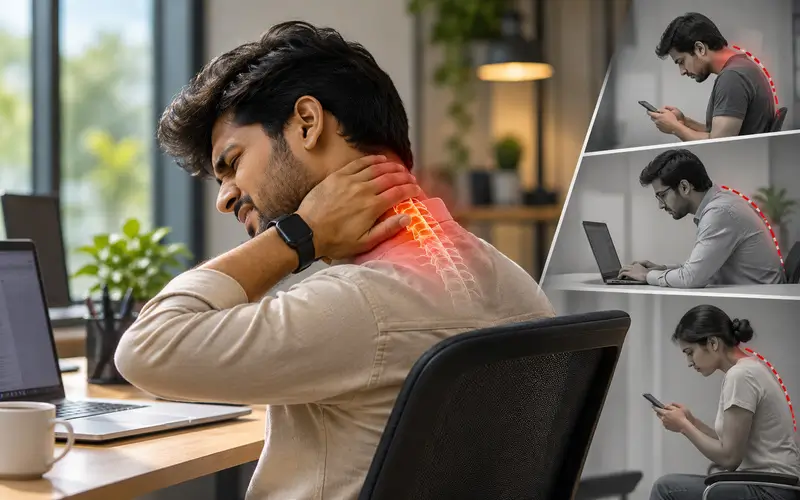
If you spend your day at a desk or scrolling on your phone, there is a good chance you have already felt the stiffness, the dull ache at the base of your skull, or the tightness that creeps across your shoulders by evening.
These are often the first signs of neck pain and cervical spondylosis, and they are no longer conditions that only affect people over 60. Today, they are showing up in office workers, students, and young professionals who are barely into their careers.
The numbers are hard to ignore. A 2025 cross-sectional study of 300 computer professionals found that 68% had symptoms typical of cervical spondylosis, with neck pain and stiffness being the most common complaints.
Globally, around 34.4% of computer workers are affected by the condition. Meanwhile, research on smartphone users in India puts the prevalence of text neck syndrome between 25% and 47%, and a 2026 study of college students in Sangli found it in 72.3% of those surveyed. In other words, the problem is widespread, and it is growing.
Here is what is actually happening inside your neck, why modern habits make it worse, and what you can do before the pain becomes a long-term problem.
What is Cervical Spondylosis?
Cervical spondylosis is age-related wear and tear of the spinal discs and joints in your neck. Your cervical spine has seven vertebrae, cushioned by discs that act as shock absorbers. Over time, these discs lose water content and flatten, the joints between vertebrae degenerate, and the body sometimes grows small bony spurs in response.
These changes can narrow the space around the spinal nerves and, in more advanced cases, press on the spinal cord itself.
Some degree of this wear is a normal part of aging. However, poor posture and repetitive strain speed the process up considerably. That is why doctors are now seeing early signs of cervical degeneration in patients in their 20s and 30s, decades earlier than expected.
You can also read: Common Knee Problems Treated by Orthopedic Doctors in Gaya
Why Desk Jobs and Phones Are Making It Worse
Your head weighs roughly 4.5 to 5.5 kilograms when it sits upright and balanced over your shoulders. Research on cervical spine loading shows that as you tilt your head forward, the effective force on your neck rises sharply.
At a 60-degree tilt, which is common when looking down at a phone, the load on the cervical spine can reach about 27 kilograms. Imagine carrying a heavy suitcase on your neck for hours every day. That is essentially what happens during long phone sessions.
Desk work adds to the problem in several ways. Screens placed too low pull the head forward. Chairs without proper support let the shoulders round. Long stretches without a break keep the same muscles locked in the same position for hours.
The 2025 study mentioned earlier found that prolonged sitting, improper chair height, and lack of back support were the main contributors among computer professionals.
Other data points in the same direction. A pooled analysis of workplace musculoskeletal disorders in India reported that neck pain affects around 40% of workers, and long desk hours, incorrect screen height, and continuous work without breaks were identified as major factors.
Among medical students in central India, 58.3% reported neck pain within the past year, with smartphone and laptop use making it worse.
The pattern is consistent. The neck is designed to hold the head in a neutral position, and sustained forward posture overloads the muscles, discs, and joints it relies on.
You can also read: Knee Pain in Young Adults: Causes, Treatment &When to see an Orthopedic Surgeon
Symptoms You Should Not Ignore
Early cervical problems are easy to dismiss because they build slowly. Watch for these signs:
– Persistent neck stiffness, especially in the morning or after long sitting
– A dull ache at the back of the neck or base of the skull
– Pain that spreads to the shoulders or between the shoulder blades
– Headaches that start in the neck and travel upward
– A grinding or clicking feeling when turning your head
– Tingling, numbness, or weakness in the arms and hands
The last one deserves special attention. Tingling or numbness that travels into the arm or fingers suggests that a nerve root is being compressed, which needs specialist evaluation rather than more home remedies.
When to See an Orthopedic Doctor
Most mild neck strain settles within a week or two with rest and posture correction. However, you should book a consultation if neck pain lasts longer than two weeks, keeps returning, or interferes with sleep and work.
Seek urgent care if you notice weakness in your arms or legs, difficulty walking or balancing, loss of grip strength, trouble with fine tasks like buttoning a shirt, or any change in bladder or bowel control. These can signal pressure on the spinal cord, which should never be left untreated.
You can also read: When Should You Consult a Pediatric Orthopedic Surgeon in Gaya?
How Cervical Spondylosis Is Diagnosed
An orthopedic specialist usually begins with a detailed history of your symptoms, work habits, and phone use. A physical examination follows, checking neck movement, muscle strength, reflexes, and sensation in the arms.
X-rays show disc space narrowing and bone spurs, while an MRI gives a clearer picture of the discs, nerves, and spinal cord when symptoms suggest nerve involvement. Together, these steps help separate simple muscle strain from true cervical degeneration, and that distinction shapes the right treatment.
Treatment Options That Actually Work
The good news is that most patients improve without surgery, particularly when they seek help early.
Physiotherapy and exercise. Targeted exercises such as chin tucks, neck strengthening, and shoulder blade stabilization are the foundation of treatment.
Research on text neck shows that chin tuck exercises significantly reduce pain and disability. Consistency matters more than intensity.
Medication. Short courses of anti-inflammatory drugs and muscle relaxants can ease acute pain and make exercise possible. They treat symptoms, not the cause, so they work best alongside physiotherapy.
Lifestyle and ergonomic changes. Raising your monitor to eye level, supporting your lower back, and holding your phone closer to eye height can reduce strain immediately.
Injections and advanced care. For persistent nerve-related pain, targeted injections may be considered.
Surgery. This is reserved for patients with significant spinal cord or nerve compression, progressive weakness, or severe pain that has not responded to other treatment.
You can also read: Why a multispecialty Hospital Is Better for Your Family’s Healthcare Needs
Simple Daily Habits to Protect Your Neck
– Follow the 20-20-20 pattern: every 20 minutes, stand, stretch, and look away from your screen
– Keep your screen at eye level and your elbows close to a 90-degree angle
– Hold your phone up toward your face instead of bending your head down
– Avoid sleeping with several thick pillows that push your neck forward
– Walk or stretch for a few minutes every hour
– Strengthen your upper back and shoulders with regular exercise
How Healing Touch Hospital Treats Neck Pain and Cervical Spondylosis in Gaya
For patients in Gaya and across Bihar, expert neck and spine care no longer means a long trip to Patna or a metro city. Healing Touch Hospital is led by Dr. Vimlendu Vimal, MBBS, D.Ortho (Patna), FIMS, and former orthopedic surgeon at ESI Hospital, New Delhi, who brings over 25 years of orthopedic experience to Gaya.
The approach at HTH begins with an accurate diagnosis. Rather than offering a generic painkiller and sending patients home, the team examines each case carefully, uses imaging where it is genuinely needed, and builds a plan around the patient’s condition, job, and daily routine.
For most patients, that means physiotherapy, medication, and practical posture guidance. When more advanced treatment is necessary, the hospital has the surgical experience and infrastructure to deliver it locally.
Patients consistently mention the clarity of communication at HTH. One patient described how the team explained every step of treatment with professionalism and compassion, while another shared that after years of recurring pain, they finally received a clear diagnosis and a structured plan that brought lasting relief.
With 24/7 emergency availability, urgent concerns such as sudden weakness or severe pain after an injury can be assessed without delay.
You can also read: Why Patients Prefer an Orthopedic Hospital in Gaya Over General Clinics
Do Not Wait for the Pain to Get Worse
Neck pain that begins as a minor annoyance can quietly progress into nerve irritation and long-term stiffness. The earlier you address posture, strength, and screen habits, the easier recovery tends to be.
Book Your Neck and Spine Consultation at Healing Touch Hospital in Gaya
If you have been living with neck pain, stiffness, or tingling in your arms, Dr. Vimlendu Vimal and the team at Healing Touch Hospital are ready to help you find the cause and treat it properly.
Call Healing Touch Hospital today at (+91) 99316 23835 or write to contact@hthgaya.com to book your consultation.
Visit at: South Church Road, Behind Hotel Gharana, Jaiprakash Nagar, Gaya, Bihar 823001.
Your neck carries your head through every day. Give it the care it deserves.