
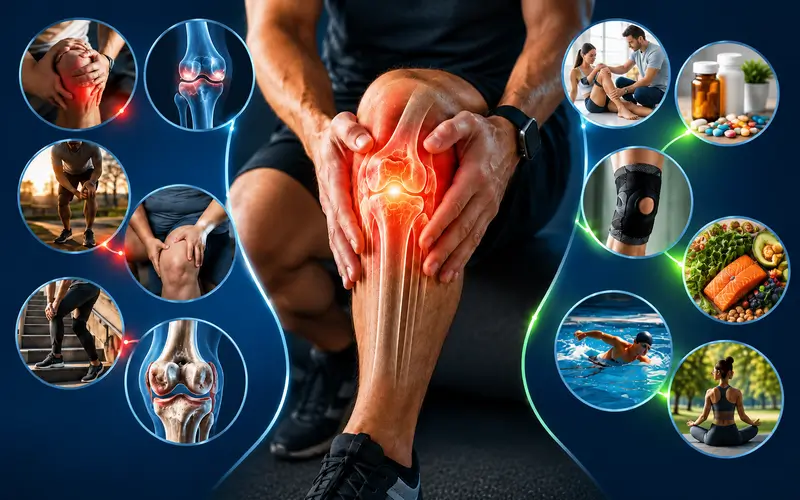
If you are searching for how to cure sore knees and what the best treatment options are, you are likely dealing with pain that has moved beyond occasional discomfort and started affecting the things you do every day, walking to the market, climbing stairs, getting up from a chair, or simply standing for more than a few minutes.
Sore knees are one of the most common orthopedic complaints in India, and they deserve a proper, informed response rather than a cycle of painkillers and ignored symptoms.
The scale of the problem is significant. The global prevalence of knee osteoarthritis reached 374.7 million cases in 2021, and projections to 2035 indicate a 43.8% increase in prevalence, making it one of the fastest-growing musculoskeletal conditions in the world.
In India specifically, the rapid increase in elderly population, obesity rates, and urbanization presents unique challenges to joint health, with knee pain emerging as a leading cause of disability and reduced quality of life across the country.
And yet, delayed diagnosis and inadequate treatment remain common, particularly outside major metro cities.
This guide explains why knees become sore, what the most common causes are, and which treatment options actually work, from simple home management to when specialist intervention becomes necessary.
Why Knees Get Sore: Understanding the Root Causes
Sore knees are not a single condition. They are a symptom that can arise from several different underlying causes, each requiring a slightly different approach to treatment.
Understanding which category your pain falls into is the first step toward addressing it correctly.
Osteoarthritis. This is the most prevalent cause of chronic knee soreness in adults over 40. It occurs when the cartilage cushioning the knee joint gradually wears away, causing the bones to rub against each other and producing pain, stiffness, and swelling that tends to worsen with activity and ease somewhat with rest.
The pain is typically described as a dull, persistent ache, often accompanied by a grinding sensation during movement. Morning stiffness that improves after 15 to 30 minutes of gentle activity is a hallmark feature.
Overuse and repetitive strain. Athletes, manual laborers, and people who spend long hours standing or walking are frequently affected by overuse injuries, such as patellofemoral pain syndrome and iliotibial band syndrome, where repeated stress on the knee structures leads to inflammation and soreness without any single traumatic event.
These conditions respond well to rest, load management, and targeted physiotherapy when caught early.
Ligament and meniscal injuries. A sudden twist, an awkward landing, or a direct impact to the knee can damage the ligaments or meniscal cartilage, both essential for joint stability and smooth movement. Soreness from these injuries is often sharper and more localized, and may be accompanied by swelling, instability, or a catching sensation inside the joint.
Bursitis and tendinitis. Inflammation of the small fluid-filled sacs around the knee, known as bursitis, or inflammation of the tendons connecting muscles to bone, known as tendinitis, produces significant soreness, particularly with specific movements.
These are common in people whose daily activities involve repetitive knee flexion or prolonged kneeling.
Referred pain from the hip or spine. Not all knee soreness originates in the knee itself. Nerve compression in the lower spine or hip problems can refer pain downward into the knee, which is one of the key reasons accurate specialist diagnosis matters so much.
Treating the knee when the real problem is in the spine will not resolve the pain.
You can also read: Common Knee Problems Treated by Orthopedic Doctors in Gaya
Effective Treatment Options for Sore Knees
Treatment for sore knees follows a logical progression from conservative management to more advanced interventions, depending on the severity of the underlying cause and how well earlier measures work.
Rest, Ice, and Activity Modification
For mild to moderate knee soreness without a clear structural injury, the first step is reducing the load on the joint. Avoiding activities that specifically aggravate the pain, applying ice for 15 to 20 minutes at a time during the first 48 to 72 hours of a flare-up, and temporarily scaling back high-impact activities gives the inflamed tissues time to settle.
This is most effective for overuse injuries and mild inflammatory flares, and it works best when implemented early rather than after weeks of pushing through the pain.
You can also read: Knee Pain in Young Adults: Causes, Treatment &When to see an Orthopedic Surgeon
Physiotherapy and Targeted Exercise
This is consistently one of the most evidence-backed treatments for chronic knee soreness. Strengthening the muscles around the knee, particularly the quadriceps and hamstrings, reduces the load on the joint itself during movement.
Flexibility exercises address tightness in surrounding structures that often contributes to poor knee mechanics.
A physiotherapist can also identify and correct movement patterns that are placing unnecessary stress on the knee, addressing a root cause rather than just managing symptoms.
For osteoarthritis specifically, physiotherapy is the standard starting point for mild to moderate cases and remains an important component of recovery even for patients who eventually require more advanced treatment.
The key is consistency. A few sessions without follow-through rarely produce lasting results, but a structured, ongoing program almost always does.
Anti-Inflammatory Medications
Non-steroidal anti-inflammatory drugs such as ibuprofen or naproxen can reduce pain and swelling in the short term, making it easier to engage in physiotherapy and daily activity.
However, they address the symptom rather than the cause, and long-term use carries gastrointestinal and cardiovascular risks.
They are most appropriately used as a short-term bridge during acute flare-ups rather than as a permanent management strategy.
Knee Injections
For patients with moderate to severe osteoarthritis or persistent inflammation not adequately addressed by physiotherapy and medication, intra-articular injections offer a more targeted approach.
Corticosteroid injections reduce inflammation directly inside the joint and can provide meaningful pain relief for several weeks to months. Hyaluronic acid injections, which supplement the natural joint fluid, work well for some patients with early to moderate osteoarthritis.
These are not permanent solutions but can meaningfully improve quality of life and delay the need for surgery in appropriate patients.
You can also read: Total Joint Replacement Surgery: When It’s Needed and What to Expect
Bracing and Supportive Devices
Knee braces and supportive sleeves reduce pain during activity by providing additional stability and compressive support.
They work best for ligament-related instability, mild to moderate osteoarthritis, and recovery from minor injuries. Custom orthotics can also help by correcting alignment issues further down the kinetic chain that contribute to abnormal knee loading.
When Surgery Becomes the Right Answer
For patients with advanced knee osteoarthritis, severe ligament tears, or meniscal damage that has not responded to conservative management, surgery offers the best path to lasting relief.
Arthroscopic procedures address meniscal tears and cartilage damage through minimally invasive keyhole surgery.
Partial or total knee replacement replaces damaged joint surfaces with prosthetic components, dramatically reducing pain and restoring function in patients for whom all other options have been exhausted.
The decision to operate always follows a thorough evaluation of the patient’s specific condition, age, activity level, and degree of functional limitation.
You can also read: Back Pain & Spine Problems: When to see an Orthopedic Surgeon
What You Should Not Do With Sore Knees
A few common mistakes consistently make knee soreness worse. Ignoring the pain and continuing high-impact activity allows minor problems to become significantly more complex ones. Self-medicating with painkillers for months without seeking a diagnosis masks symptoms while the damage continues.
Resting completely without any movement, particularly for osteoarthritis, weakens surrounding muscles further, making the joint less supported and more painful. And applying heat during the first 48 hours of an acute flare-up increases inflammation rather than reducing it.
You can also Read this : 5 Tips to Choose the Best Orthopedic Doctor in Gaya for Joint and Bone Problems
How Healing Touch Hospital Treats Sore Knees in Gaya
For patients in Gaya and across Bihar who are tired of managing knee soreness without a clear diagnosis or a real treatment plan, Healing Touch Hospital offers the specialist orthopedic evaluation and care that makes the difference.
Led by Dr. Vimlendu Vimal, MBBS, D.Ortho (Patna), FIMS, and former orthopedic surgeon at ESI Hospital New Delhi, HTH brings over 25 years of dedicated orthopedic experience directly to Gaya, with no need to travel to Patna or Delhi for expert knee care.
Dr. Vimlendu’s approach begins with accurate diagnosis: identifying the specific cause of each patient’s soreness through detailed clinical examination and appropriate imaging, rather than applying a generic protocol.
From there, the team builds a personalized plan that starts conservatively and escalates only when genuinely necessary.
For patients requiring advanced interventions like injections, arthroscopy, or knee replacement, HTH has the surgical infrastructure and expertise to deliver these with skill and care.
Patients consistently describe the quality of communication as one of the most valued aspects of their experience at HTH. One patient described finally walking without knee pain after years of suffering and called it the best orthopedic care in Gaya.
Another praised the team’s willingness to explain every step of treatment clearly, making what felt like an anxiety-inducing situation feel manageable and building genuine confidence in the care being received.
With 24/7 emergency availability, HTH also ensures that sudden knee injuries or acute pain flare-ups do not require a long wait or an exhausting trip to a distant hospital.
Stop Waiting for the Pain to Go Away on Its Own
Sore knees rarely improve significantly without the right intervention. The earlier an accurate diagnosis is made and the right treatment plan is put in place, the better the outcome and the smaller the chance of needing more complex treatment further down the line.
Book Your Knee Consultation at Healing Touch Hospital, Gaya
If knee soreness is limiting your daily life and you want a clear answer about what is causing it and how to treat it properly, Dr. Vimlendu Vimal and the team at Healing Touch Hospital are ready to help.
Call Healing Touch Hospital today at (+91) 99316 23835 or write to contact@hthgaya.com to book your consultation.
Visit at: South Church Road, Behind Hotel Gharana, Jaiprakash Nagar, Gaya, Bihar 823001.
Your knees deserve more than just pain management. They deserve the right care.